
11 November 2026
Letter size and word spacing: the two fixes that change handwriting most
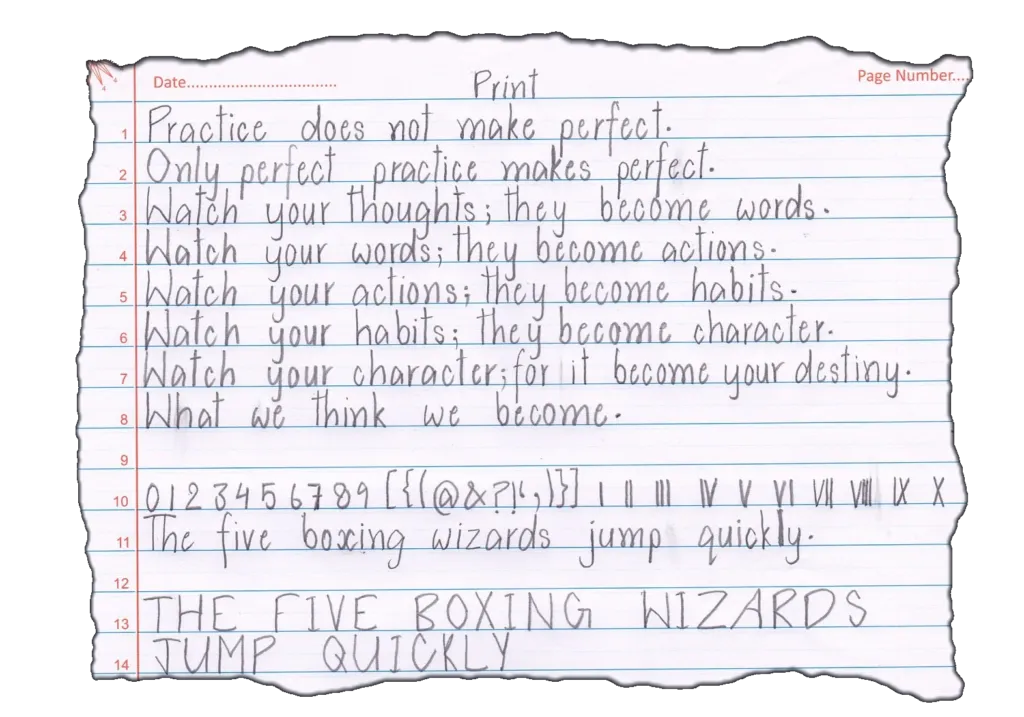
If you change only two things in your child’s handwriting, change letter size and word spacing. Handwriting looks neat when the small letters are all the same height and the gaps between words are all the same width. Even unusual letter shapes look tidy when these two are steady. Messy handwriting nearly always breaks one or both.
Why these two matter most
When a reader looks at a page, the eye reads the overall pattern before it reads the letters. Even sizes and even gaps make a regular pattern, and the page looks neat. Letters that jump in size, or words that run together, break the pattern, and the page looks rushed even if each letter is well formed. They are also the easiest things to fix, because they are simple to measure.
Check letter size in one minute
Take a page your child wrote recently and look at the small letters: a, c, e, m, n, o, r, s, u.
- Are they all the same height?
- Do they sit on the line, or float above it?
- Do the tall letters (b, d, h, k, l) reach the same height as each other?
- Is the first line the same size as the last line on the page?
Draw a light pencil line across the tops of the small letters in one sentence. If the line is straight, the size is steady. If it zigzags, size is the first fix.
Check word spacing
Look at the gaps between words in the same sentence:
- Can you see where one word ends and the next begins?
- Are the gaps roughly the same width?
- Are the gaps between letters inside a word smaller than the gaps between words?
A simple rule of thumb: the gap between words should be about the width of a small “o”.
Exercises for steady letter size
- Use a four-line notebook for two weeks. The middle space shows exactly how tall a small letter should be. Our guide to four-line notebook writing lists the letter groups.
- Practise by group, not alphabet. Write a row of middle-space letters (c, o, a, e), then a row of tall letters (l, h, k), then a row of tails (g, p, y).
- Copy one short sentence three times a day. Draw the line across the tops afterwards, together, and see whether it is straighter than yesterday’s.
Exercises for word spacing
- The finger space. Young children can place a finger after each word before starting the next. Older children can use the width of a small “o”.
- The spacer stick. A lollipop stick or a strip of card placed after each word works the same way and feels like a game.
- Write slower for one week. Spacing collapses when a child rushes. Once the habit settles, speed comes back.
- Space between letters too. Letters inside a word should be close but not touching, closer than the gap between words.
How long does it take?
With ten minutes of practice a day, most children show steadier size and spacing within a couple of weeks. In our classes, most students see a change within 7 days of the first class, and in their school notebook within about 15 days.
Common mistakes
- Letters that grow bigger as the child gets tired, towards the end of the page.
- Squeezing the last word into the end of a line instead of starting a new line.
- Very large gaps that make a sentence look like a list of words.
- Correcting letter shapes first, while size and spacing stay uneven.
Where speed fits in
Size and spacing come first, speed second. Once both are steady, timed practice brings the speed back without losing the neatness.
Not sure where your child’s writing stands? Send one page through the free handwriting check. Letter size and spacing are on the list of things Sudhir Sir looks at, along with slant, grip and speed.
Frequently asked questions
What makes handwriting look neat?
Mostly two things: small letters that are all the same height, and gaps between words that are all the same width.
How much space should be between words?
About the width of a small “o”. Young children can use a finger space.
Why are my child’s letters different sizes?
Usually because they write without a guide, rush, or get tired. A four-line notebook and short daily practice by letter group fix it.
How do I stop my child’s words running together?
Use a finger space or a spacer stick after each word for a few weeks, and slow down a little until the habit settles.
Should letters in a word touch each other?
In print, letters should sit close but not touch. In cursive and semi-cursive, joined letters connect with a short stroke.
Book a free trial class