31 October 2026
Handwriting for UPSC: the rules and how to improve it
Handwriting matters in UPSC because the Civil Services Main exam is written by hand, and its rules say that if a candidate’s handwriting is not easily legible, marks are deducted from the total. Each paper runs for three hours, and a General Studies paper asks for about 4,000 words. So UPSC needs handwriting a stranger can read at a glance, written at about 25 words a minute, that looks the same in the last answer as in the first.
What the UPSC rules say about handwriting
The UPSC notice for the Civil Services Examination 2026 sets the rules for Mains. Four of them are about how you write:
- “Candidates must write the papers in their own hand.” A scribe is allowed only for some candidates with benchmark disabilities.
- “If a candidate’s handwriting is not easily legible, a deduction will be made on this account from the total marks otherwise accruing to the candidate.”
- “Credit will be given for orderly, effective and exact expression combined with due economy of words in all subjects of the examination.”
- Numbers must be written in the international form of Indian numerals: 1, 2, 3 and so on.
The notice does not say how many marks are cut, and it names no style of handwriting.
How much you write in one General Studies paper
The 2026 General Studies Paper I shows the load. It had 20 compulsory questions and 250 marks in three hours. Questions 1 to 10 were to be answered in 150 words and carried 10 marks each. Questions 11 to 20 were to be answered in 250 words and carried 15 marks each.
| Part of the paper | Questions | Words each | Marks each | Words in total |
|---|---|---|---|---|
| Short answers | 10 | 150 | 10 | 1,500 |
| Long answers | 10 | 250 | 15 | 2,500 |
| Whole paper | 20 | 250 marks | 4,000 |
That is 4,000 words in 180 minutes: about 22 words a minute if you never stop to think. Keep 20 minutes for reading the questions and planning, and you need 25 words a minute. Split by marks, a 10-mark answer gets about 7 minutes and a 15-mark answer about 11.
Mains has nine papers of this kind, each three hours long: the Essay, four General Studies papers, two papers in your optional subject, and two qualifying language papers, and your handwriting has to last through all of them.
Does handwriting really change marks?
UPSC does not publish how its examiners mark, but research on scoring shows that the same answer scores lower when it is harder to read. A 2011 review by Steve Graham, Karen Harris and Michael Hebert pooled experiments in which scorers marked more legible and less legible copies of the same text. For a college student with poor handwriting, a typical paper fell from the 50th percentile to somewhere between the 48th and the 23rd. And an examiner who cannot read a word cannot give marks for the idea in it.
Is cursive allowed in UPSC?
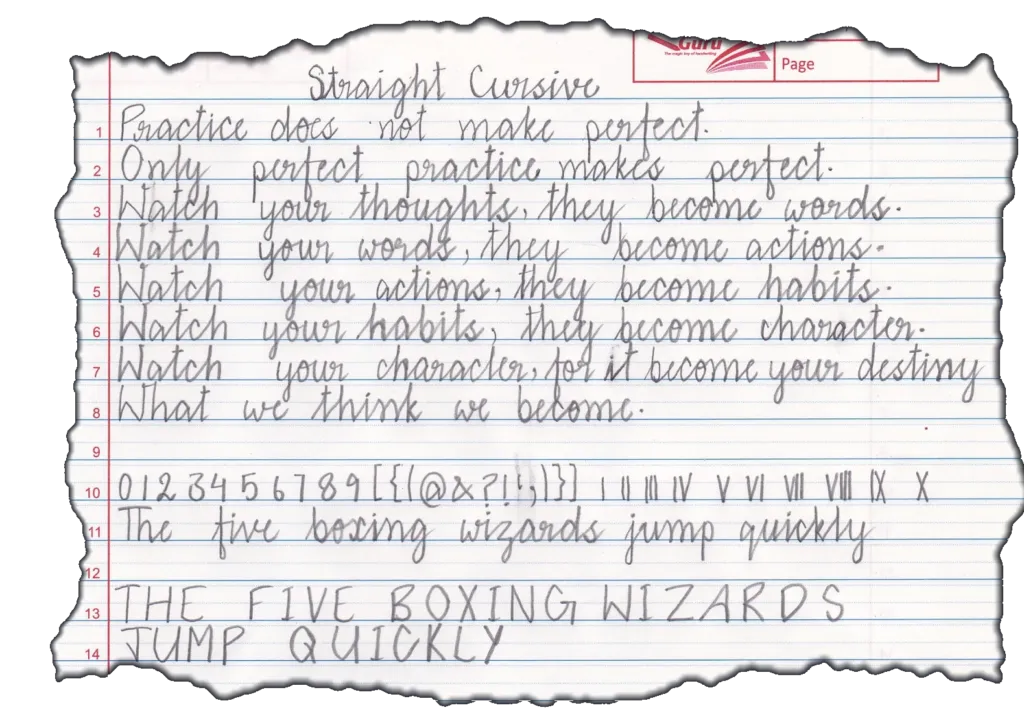
Yes. The rules do not ask for any style, so print, semi-cursive and cursive are all allowed as long as every word is easily legible. Pick the style you can write fastest without the letters losing their shape. If your joined writing turns into a scrawl when you hurry, try semi-cursive, where some letters join and some stand apart. Our guide to semi-cursive handwriting shows how it works, and types of handwriting compares all four styles.
How to improve your handwriting for UPSC
Fix legibility first, then speed, then stamina. Speed built on unclear letters only makes them worse.
- Test where you stand. Write one 250-word answer against a stopwatch and note the minutes. Then ask someone who has never seen your writing to read it aloud. An examiner may stop at the same words.
- Fix the letters that get mistaken for each other. The usual pairs are a and o, u and v, n and h, r and v, and the numerals 1 and 7. Close every a, give every h a tall stem, and keep each pair clearly different.
- Keep letter size steady and leave a clear gap between words. A page of even letters with clear spaces is quick to read, even when the letters are plain.
- Check your grip and posture. A tight grip tires the hand, and each Mains paper takes three hours. Our guide to holding a pencil correctly is written for children, but the grip is the same for a pen in an adult hand.
- Practise with the pen you will use in the exam. A new pen changes how your letters come out, so choose one that does not smudge and stay with it.
- Build speed with timed answers: 150 words in 7 minutes, 250 words in 11. Speed often dips for a few days while the hand gets used to new letter shapes, then climbs past where it started.
- Build stamina with full papers. Once a week, write a whole three-hour paper in one sitting, then compare the last page with the first. If the last answers are harder to read, slow down in practice until they are not.
Presenting your answers in the booklet
You write in a Question-cum-Answer (QCA) Booklet, in the space given under each question. The 2026 paper adds one more instruction: any page or part of a page you leave blank must be clearly struck off.
- Open each answer with one or two lines that address the question, then give your points, then a short conclusion.
- Leave a line between points, so the examiner can see where each one starts.
- Underline a few terms the question asks about, never whole lines.
- Use a simple diagram or flowchart where it says more than a paragraph would.
- Write numbers as 1, 2, 3, as the rules ask.
Write your notes by hand too
UPSC preparation means months of note-making. If you make those notes by hand instead of typing them, your hand gets daily practice at the speed you will need. It may help you learn as well: a 2024 EEG study of university students found far more widespread connectivity in the brain when they wrote words by hand than when they typed them, a pattern the researchers link to memory and learning.
Can an adult still improve their handwriting?
Yes. Handwriting is a skill of the hand, and adults change it the same way children do: by correcting a few letter shapes and practising them until they come without thought. Most of our students see a change within 7 days of their first class.
Writing Guru teaches adults as well as children, one-on-one: at your home across Delhi NCR, or live on Google Meet anywhere in India. Classes follow the LV Method, which teaches every letter as a short sequence of four basic strokes, so each letter is formed the same way every time. Read more about our UPSC handwriting classes and handwriting classes for adults.
To see what to fix first, send one page of your writing for the free handwriting check. Sudhir Sir will reply with the three changes that will help most.
Frequently asked questions
Does handwriting matter in UPSC Mains?
Yes. The UPSC notice says that if a candidate’s handwriting is not easily legible, marks will be deducted from the total. Mains is written by hand in nine three-hour papers, so legibility affects every answer.
Is cursive writing allowed in UPSC?
Yes. The rules do not ask for any style. Print, semi-cursive and cursive are all allowed, as long as every word is easily legible.
How many words per minute do I need for UPSC Mains?
About 22 to 25. A General Studies paper asks for about 4,000 words in three hours: ten answers of 150 words and ten of 250 words.
How long does it take to improve handwriting for UPSC?
Letter shapes can change within a week of daily practice. Speed takes longer, because it often dips for a few days before it climbs. Start a few months before Mains, so the new handwriting is automatic by exam day.
Can I take handwriting classes for UPSC online?
Yes. Writing Guru teaches one-on-one on Google Meet anywhere in India, and at your home across Delhi NCR.
Sources
- Union Public Service Commission, Examination Notice No. 05/2026-CSE, Civil Services Examination 2026, 4 February 2026. upsc.gov.in
- Union Public Service Commission, Civil Services (Main) Examination 2026, General Studies Paper I. upsc.gov.in
- Graham, S., Harris, K. R. and Hebert, M. (2011). It is more than just the message: presentation effects in scoring writing. Focus on Exceptional Children, 44(4), 1-12. doi.org/10.17161/foec.v44i4.6687
- Van der Weel, F. R. and Van der Meer, A. L. H. (2024). Handwriting but not typewriting leads to widespread brain connectivity: a high-density EEG study with implications for the classroom. Frontiers in Psychology, 14. doi.org/10.3389/fpsyg.2023.1219945