
6 November 2026
Handwriting for a left-handed child: how to teach it right
A left-handed child can write as neatly and as fast as anyone. They need a few things set up differently: the page tilted the other way, the hand a little further up the pencil, a seat on the left of a shared desk, and a pen that dries quickly. Most of the trouble left-handed children have comes from copying a right-handed setup.
Never switch the hand
If your child picks up the pencil with the left hand, let them. Forcing a child to write with the other hand slows them down, frustrates them, and rarely gives better writing. The goal is to make the left hand comfortable.
Tilt the paper the other way
A right-handed writer tilts the top of the page to the left. A left-handed writer should do the opposite: place the page slightly to the left of the body and turn its top edge to the right. This lets the hand move across the line from below, without curling over the top of the writing.
Try a few angles and keep the one where your child can see what they have just written.
Hold the pencil a little higher
The grip is the same tripod grip a right-handed child uses: thumb and index finger, pencil resting on the middle finger, light pressure. The difference is height. Holding the pencil about three centimetres from the tip, a little higher than usual, lets a left-handed child see the letters instead of covering them with their fingers. Our guide on how to hold a pencil correctly covers the grip itself.
Watch for the hooked wrist
Many left-handed children bend the wrist so the hand hooks over the top of the line. They do it to see their writing, or because the page is tilted the wrong way. It tires the wrist and smudges the page. The fix is usually the page angle and the grip height above, not telling the child to straighten the wrist.
Set up the desk
- At a shared desk, seat a left-handed child on the left, so their elbow does not bump a right-handed neighbour.
- Light from the right side keeps the hand’s shadow off the writing.
- Keep the notebook to the left of the body’s centre, not straight in front.
- Spiral notebooks are awkward for a left hand. A notebook with the spiral at the top, or a plain bound one, works better.
Choose a pen that does not smudge
The left hand moves over what it has just written, so slow-drying ink smears. Pencils, quick-drying gel pens and ballpoints work well. Very wet ink and some fountain pens smudge more. Let your child try a few and keep the one that stays clean. You can see the pens and pencils we suggest on our recommended tools page.
The slant: upright is fine
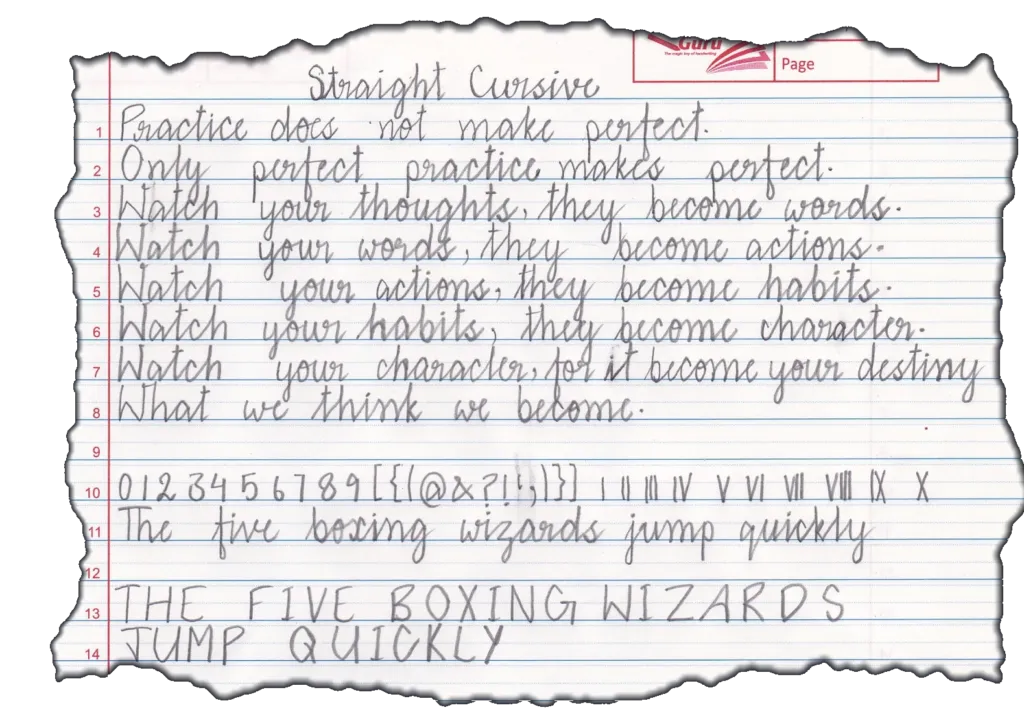
A strong right slant is hard for a left hand. Upright writing, or a very gentle slant, is often more natural. That is why straight cursive or upright semi-cursive often suits left-handed children. See straight vs slanting cursive for the difference.
Letter shapes that need care
A few strokes run the other way for a left hand. Crossing a t, for example, is often easier from right to left. That is fine as long as the result looks the same. Do not correct the direction of a stroke if the letter comes out right and the hand stays relaxed.
A short daily routine
- Two minutes of loops and lines with the page at the new angle.
- One row of a letter group in a four-line notebook.
- Two sentences copied from a book.
- A check: are the letters on the line, and is the page clean?
Common mistakes
- Copying a right-handed setup: the page tilted left, the notebook straight ahead.
- Holding the pencil too close to the tip, which hides the writing.
- Correcting a hooked wrist without changing the page angle first.
- Expecting a strong right slant.
Send one page through the free handwriting check, and Sudhir Sir will look at the grip, slant and spacing.
Frequently asked questions
How do you teach a left-handed child to write?
Tilt the page so its top edge turns to the right, place it a little to the left of the body, hold the pencil slightly higher than usual, and use a pen that dries quickly.
Should a left-handed child be made to write with the right hand?
No. Switching hands slows the child down and causes frustration. Set up the page and grip for the left hand instead.
How do I stop my left-handed child smudging their writing?
Use a pencil or a quick-drying gel or ballpoint pen, tilt the page so the hand moves below the line, and avoid very wet ink.
Which handwriting style is best for left-handed children?
Often an upright style, such as straight cursive or upright semi-cursive. A strong right slant is hard for a left hand.
Why does my left-handed child hook their wrist?
Usually to see what they are writing, or because the page is tilted the wrong way. Fix the page angle and grip height first.
Book a free trial class