
18 November 2026
Correct sitting posture for writing: a checklist for children
Good writing posture starts at the feet: they rest flat on the floor, the back leans against the chair, the forearms rest on the desk, and the notebook is tilted a little towards the writing hand. A child who sits this way can write longer without tiring, and their letters come out steadier. A child who slouches, perches on the edge of the chair or writes with the page flat and square usually tires fast, and the handwriting shows it.
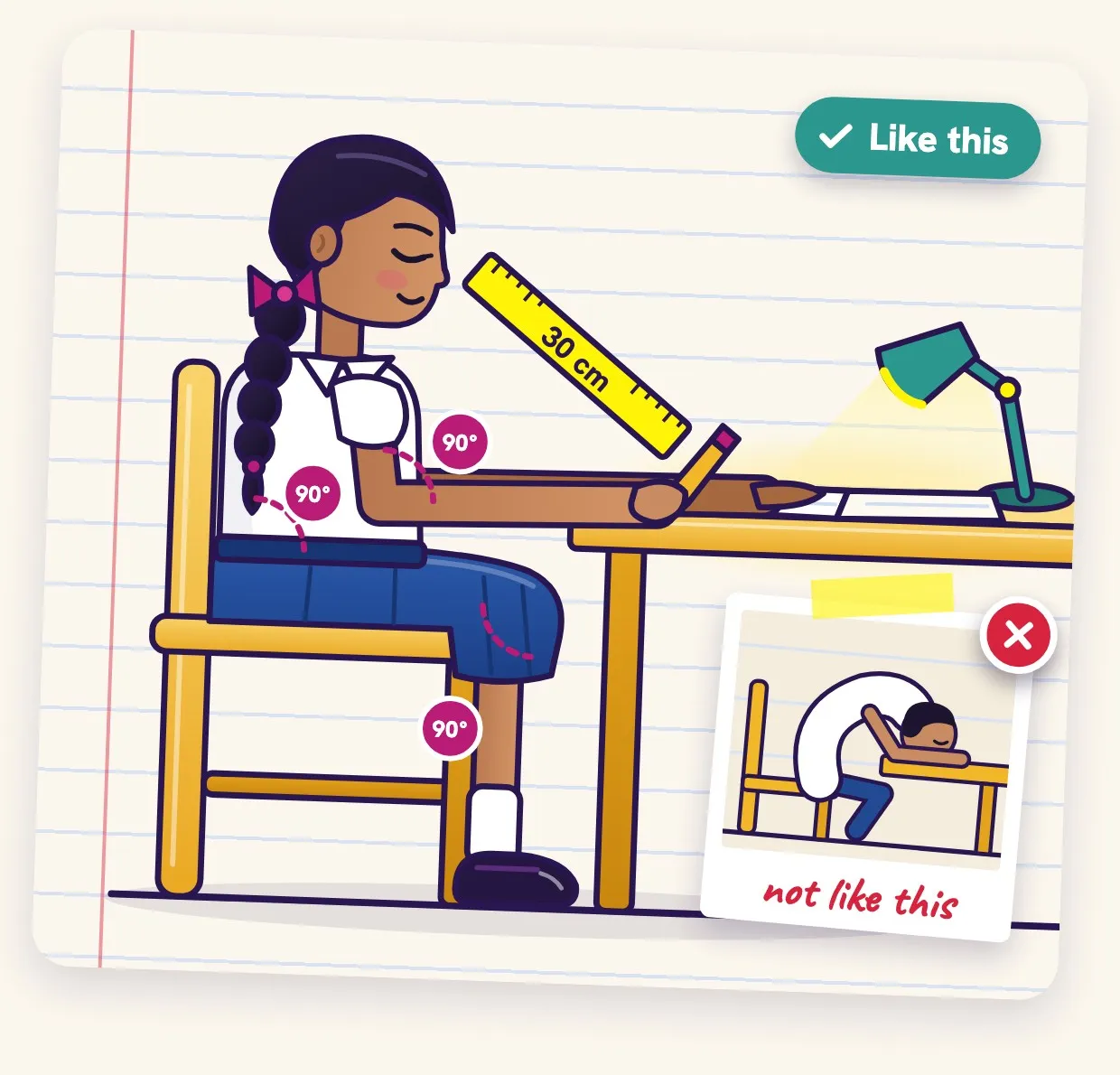
The posture checklist, from the floor up
- Feet flat on the floor. If they do not reach, put a box or a few thick books under them.
- Knees at about a right angle, level with the hips or slightly lower.
- Back against the backrest, sitting all the way back in the chair.
- Shoulders relaxed, not raised towards the ears.
- Both forearms resting on the desk, the elbows close to the body.
- Head upright, eyes about 30 centimetres from the page, roughly the length from the elbow to the knuckles.
- The other hand flat on the page, holding it still.
Read the list aloud with your child the first few times, then let them check themselves.
Chair and desk height
| Check | What you want | Quick fix |
|---|---|---|
| Chair height | Feet flat, knees at a right angle | Footrest, box or books under the feet |
| Desk height | Desk edge at about the bottom of the ribs when seated | Cushion on the chair if the desk is too high |
| Chair depth | Back touches the backrest, knees just past the seat | Cushion behind the back if the seat is deep |
| Distance to the desk | Close enough to rest both forearms | Pull the chair in |
Children grow quickly, so check the set-up again every few months.
Placing the notebook
Tilt the notebook a little: for a right-handed child, the top edge turns slightly to the left, and the page sits a little to the right of the body’s centre. For a left-handed child, do the opposite. The tilt lets the hand move along the line without the wrist bending awkwardly. Our guide to handwriting for a left-handed child covers the left-handed set-up in detail.
Light
Light should come from the side opposite the writing hand, so the hand’s shadow does not fall on the line. For a right-handed child, that means a lamp or window on the left. A steady, bright light reduces leaning forward to see.
Habits that ruin posture
- Writing on the bed or the floor, with the notebook on the lap.
- Leaning the head on the non-writing arm.
- Sitting on the edge of the chair.
- Hunching close to the page, often a sign the light is poor, or that an eye test is due.
- Long sessions without a break.
Breaks
For young children, a short break every 15 to 20 minutes helps: stand up, shake out the hands, roll the shoulders. Older children can go a little longer. Tired muscles bring the slouch back.
Posture and grip go together
A good grip with poor posture still tires the hand, and the opposite is true too. Check both. Our guide on how to hold a pencil correctly covers the grip. If your child’s writing is messy for no clear reason, posture is one of the first things to look at.
Our recommended tools page lists a kids’ chair with a backrest, a foldable book stand and a table lamp for a good writing corner at home.
Send a photo of one page through the free handwriting check, and Sudhir Sir will look at the letter size, spacing, slant, grip and speed.
Frequently asked questions
What is the correct sitting posture for writing?
Feet flat on the floor, back against the chair, both forearms on the desk, shoulders relaxed, head upright, and the notebook tilted slightly towards the writing hand.
How far should the eyes be from the page when writing?
About 30 centimetres, roughly the length from the elbow to the knuckles.
Does posture affect handwriting?
Yes. Poor posture tires the hand and shoulder faster, and tired muscles produce shaky, uneven letters.
What is the right desk height for a child?
When your child sits with feet flat, the desk edge should be at about the bottom of their ribs, so both forearms rest on it comfortably.
Why does my child lean so close to the page?
Often because of poor light or a habit, and sometimes because of eyesight. If it continues after fixing the light and posture, get an eye test.
Book a free trial class